Pages

Mexico City


Tuesday 7 November 2017 A stroll around the historic centre of Mexico City

After a somewhat stressful start - nw cards not doing what they are supposed to do - we eventually got out and strolled through a very pleasant park, past the Palicido de Bellas Artes, an incredibly beautiful building. The inside is equally beautiful and well worth a visit.


Palicido de Bellas Artes


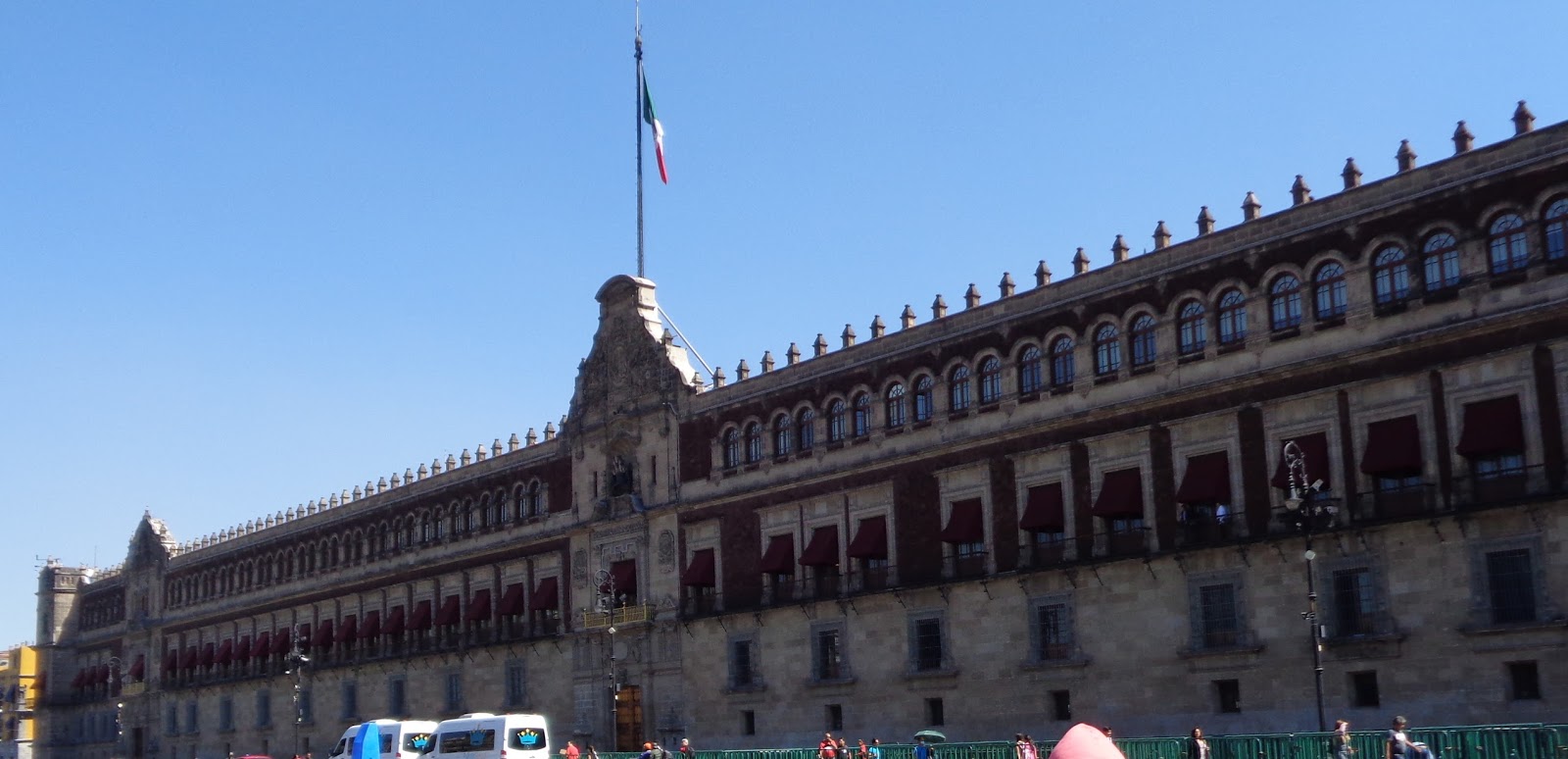
The Palacio National that we see today is a reconstruction that was completed in 1693, replacing the previous two that burnt down in 1659 and 1692. Taking up the entire east side of the plaz, it was built on the site of Moctezuma's palace when the Aztecs were  annihilated by the Conquistadors.

The palace is free to enter provided you can leave a passport or ID card - both of ours were back at the apartment.  Then Jorge introduced himself to us saying that  if we hired him as a guide, his ID would be enough to get us in. We knew that it was now or never.

He gave us the history of the complex but the most interesting part was the murals, painted by Diego Rivera between 1929 and 1935. The entire staircase and all around the first floor is a grand sweep of the history of the Mexicans. From the belief that the ancients were taught astronomy by the Vikings through the fact that most ordinary people welcomed the Conquistadors because of the fondness that the Aztecs had for human sacrifice and the much later American invasion stole over a third of Mexican territory. 


We had a look at the ruins of the Aztec palace, but it really is just a lump of stones held together with mortar. There is quite a lot of information dotted around the fenced off structure, in both Spanish and English, some of it suggesting that the rest of it was used in the construction of the cathedral right next door.


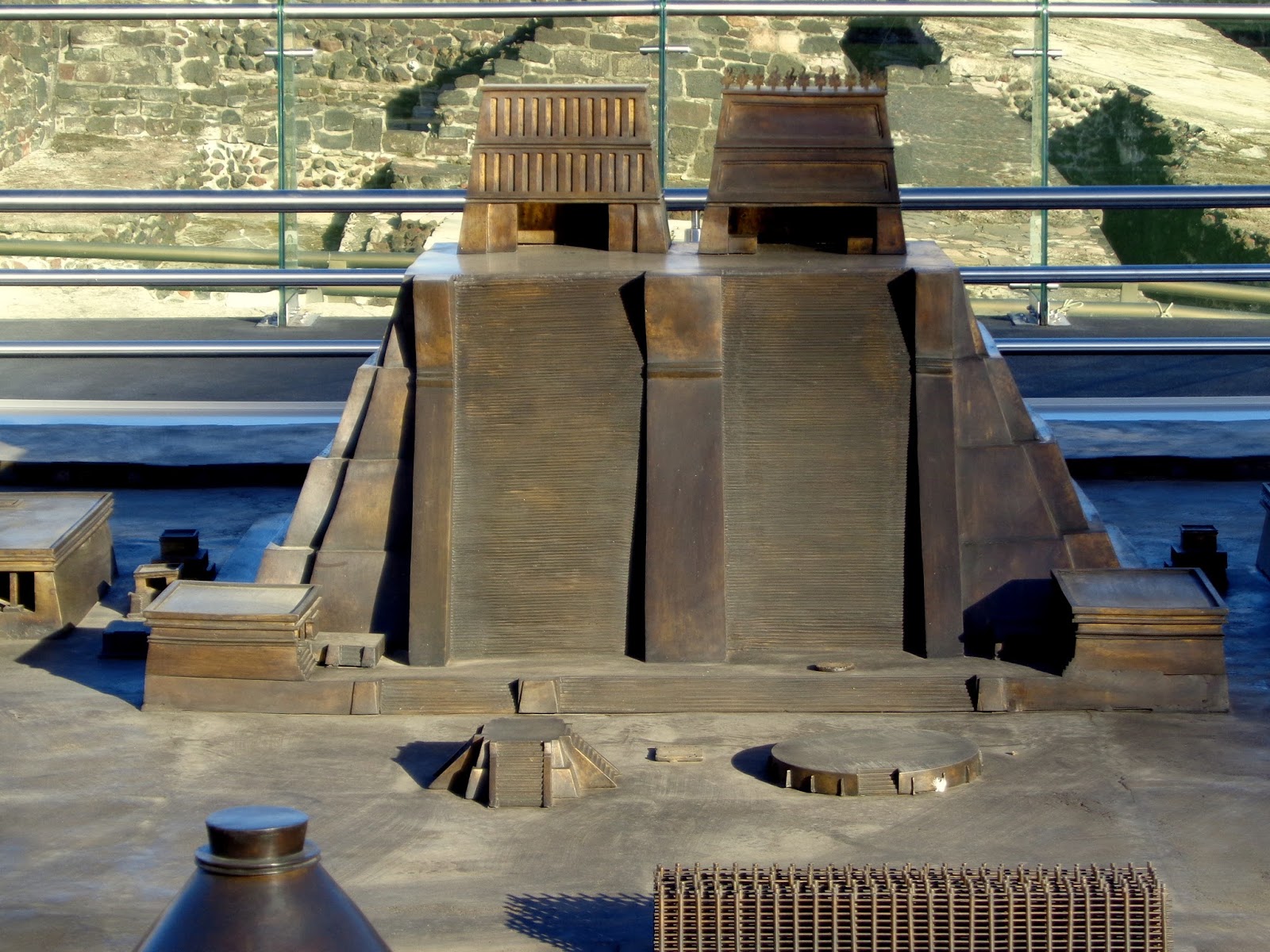
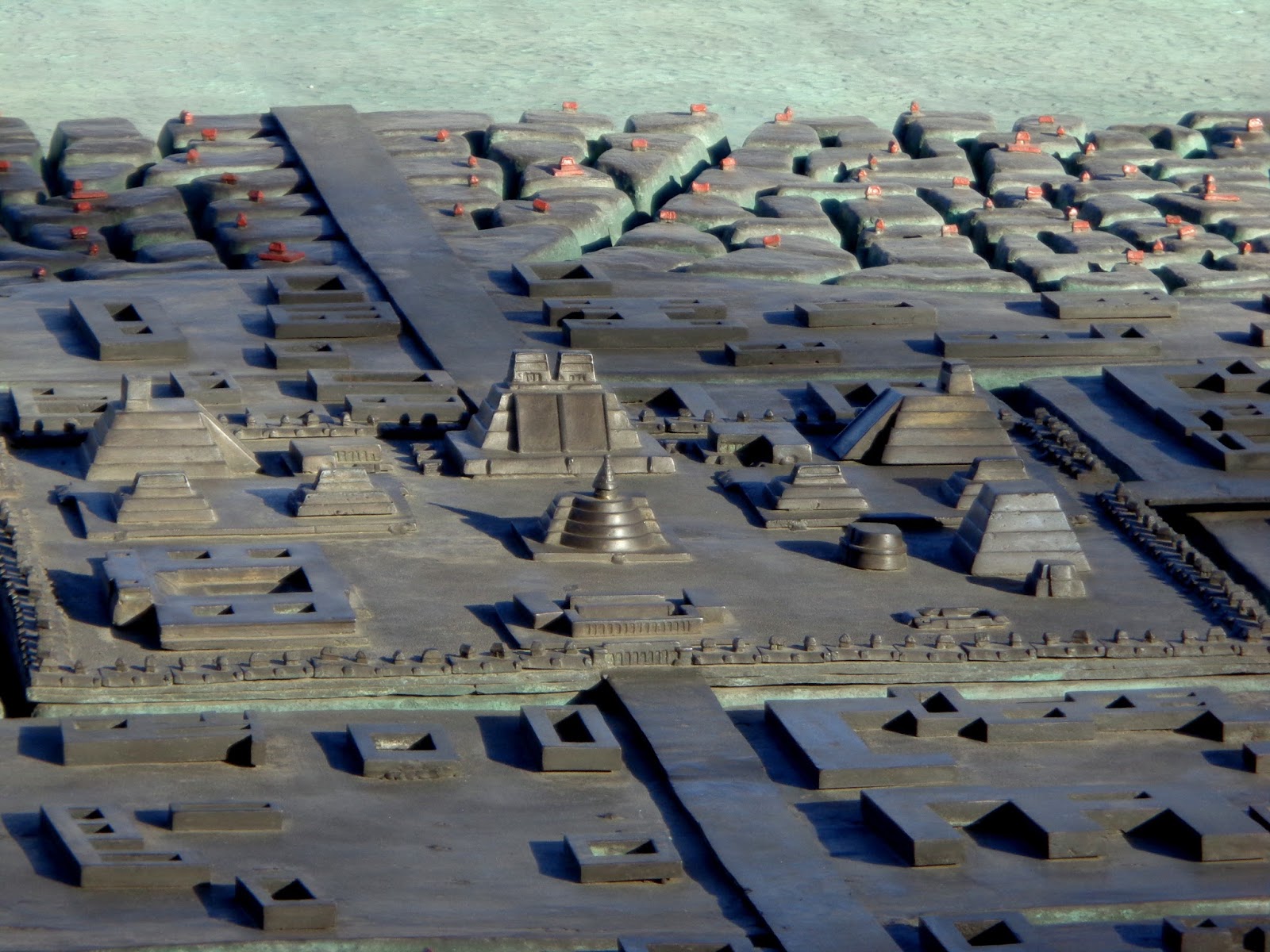
Luckily there are a couple of really good models of the complex in its heyday.

These temples are often depicted with blood running out of the opening and down the steps to portray the daily sacrifices carried out by the Aztecs - something about keeping the sun fuelled, I believe.


Wednesday 8 November

Chapultepec Park

We had quite an adventure getting here. The nearest metro stop to our apartment turned out to be out to be a metro-bus stop - a two carriage, modern bus - but we had to 'pay' to get on the platform. So we stood back and watched a couple of locals go through, while also translating the instructions between us when a young lady offered to help. Not only did she help us buy a travel card but she happened to be going in the same direction, so she led us three stops on the bus before changing to the metro and telling us where to get off.

Public transport in the city is reliable, comfortable and cheap.

The bridge crossing the eight-lane highway from the metro station  is dotted with the current exhibition - photographs enlarging the minute, and lead to the entrance of the park

Six pillars at the entrance - Bosque de Chapultepec - Monumento a Los Niños Hèroes celebrates the bravery of the last cadet standing after the Americans had slaughtered all the others.


The art gallery - Meuso de Arte Monderno

The Castle - museo Naional de Historia

The Antropología Museo

Thursday 9 November
Teotihuacan - Pirámide de la Luna

La Paz

Saturday 11th November
Snorkeling with whale sharks is something both of us have wanted to do since we first saw someone do it on the telly.

We were pitched along the Malacon for a cost of 700 pesos each. For an extra 100 peaos the took us back, in the boat, to La Concha, amd pitched up on the beach to pick up swimming costumes.

As luck had it,  we had the boat and crew to ourselves. The guide stood up at the bow looking for ahead for shadows.  When she spots her target she jumps in, and if all is well and good, signals to us and we jump in.

I not sure that I believed I was actually going to see anything, but once I got myself sorted and looked down there was this massive creature coming straight at me. It us really difficult to express just how awesome it is to be that close.

Eventually, it swam on past us and we got back in the boat. Our guide took up het vigil immediately and was soon telling us to eady ourselves again.

The second time,  we came across a mother and baby.  The baby's mouth was big enough to accommodate an adult human. We could of had a party in mum's mouth.

They are truly magnificent, huge, majestic. And we were were close enough to touch.  They weren't bothered by us at all.

Sunday 12th November
Snorkeling with sea lions is another lifelong wish and we had a whole day at sea for the same price (plus 100 pax mxn commission).

There were  10 of us and two crew. The boat takes us to the south of La Paz, past some secluded sandy beaches, over the channel and up the side of the islands just off La Paz.

We saw the largest Frigate bird colony in the world, he drove us through a sea eroded arch and showed us another rock that has eroded into a mask. Then onto the sealuon colony, first sowing us yhe nursery and then lettting us snorkel in the water with the slightly older and bigger sea lions

One of the crew stayed on board,  the other led the rest of us.

Really seemed care about the environment.

Monday 13th November

Hired a car and drove around the tip of the peninsula south of la paz.

We stopped at Todos Santos, a very small but colourful town full of little artisan outlets selling expensive but quality jewellery, leather goods and other tourist souvenirs.

Our next stop was at ******* for our first sight of The Pacific and watched ad fishermen beached thier boats.

The time eas not in our side.   The guide book made it out to be less than 250 kms. We actually drove 458. 70 of which was an unmade/sand road between San Jose de Cabo and La Paz which followed the coast and gave access to beautiful beaches. 

Sadly, we did most of it in the dark and unable to see any but the first few, and it was a grueling part.

Sadly,  we also didn't see anything of the mountains we had to drive over ro complete our journey.

To be honest, we should stayed one night in San Jose de Cabo and made a day of the last part of the trip.

Mexico - here we come

Sunday 8th October, 2017

We were just talking about going on another trip. I suggested Mexico.

Paul fished out some issues of Wanderlust and the nest thing we knew, we were booking two return flights.

Then Paul checked the foreign office -  There's drug related violence, political related violence, not to mention the recent devastating earthquakes! Someone else told us that Mexico was the only place her mother, who had backpacked around most of the world, had been mugged.

But the Mexican's, it would seem, have been badly treated. Here is a quick resume:

1519  Cortex lands in Veracruz on the Gulf of Mexico.
1521  Mexico city built on the ruins of the Aztec city of Tenochtitlan to become the capital city of                New Spain.
1525  Most of the pre-invasion population have been slaughtered by sword or desease.
1524  Chritianity arrives in the guise of Franciscan monks.
1546 The Spanish discover silver.
1560-90  Chichimeca war.
1551  Spanish Conquistadors take the Yucatan peninsular.
1810 Mexican War of Independence
1846 Mexican/US war provoked by the US ended 2 years later with Mexico conceding almost half of her territory to the US
1912 Mexican Revolution finally gets rid of the idiot that lost the territory.
1917 Mexican constitution
1997 North American free trade agreement - Canada, US and Mexico.

Googlemaps


We're off to India

It's cold and dark and windy in good old Bognor - but we only have 19 days until we start our new adventure.

This is a practice post from my Android.

El Clalafate

We had intended to visit El Chalten, then come back to El Calafate and then cross over to Chile at the nearest point to here.  However, as we were researching, we changed our plans and will be going north to Los Antiguos (a 12 hour bus journey) for three nights, and on to Esquel (and another 12 hours bus journey).  A lot of this journey will be on the Ruta 40, which not tarmacked all of the way.

The bus picked us up at in El Chalten about 9:45 and we finally got to our hotel in El Calafate at about 13:00.  The scenery didn’t seem to be quite to awe inspiring as it did on the way to El Chalten; the golden sun-down hour can make such a difference.  El Calafate is named after the fruit, similar to a blueberry, which grows in the region.  (It is amazing that anything can grow in Patagonia, Argentinian’s steppe, because the is little rain and a great deal of wind).

We chose our hotel, the Koi Aiken, because of its view of Lago de Angentino.  Its other main benefit (also its main set-back) is that the centre of town is a thirty minute walk away.  After arriving, we had to go into town to replenish cash and investigate excursions to the Glacier Perito Moreno and car hire.  The cash was sorted quickly, but these machines will only let you have AR$1000.00 a time, that’s about £100, which doesn’t go very far but makes sure they get plenty of commission/fees.  Early December is the beginning of the main summer season and we were surprised to find that one of the hire companies had no vehicles left and another had only 4X4 monsters at AR$2400.00 (£240.00) per day with a maximum of 200 kms.  200 kms is nothing in this area.  It is 88kms to get to the glacier - and 88kms back.  And you would, no doubt, have to pay for petrol on top of that.


Our room, on the ground floor, does have a restricted view but at the top of the hotel there is a guest lounge with incredible views of the lake and the bordering wetland (that boasts over 150 different species of bird) together with views of the entire town.  We brought our second cup of breakfast coffee up here and we had the place to ourselves.  It is now 11:30 and we still have the place to ourselves.  Paul is doing his pilates and I am enjoying the rest, and the view.

The excursion we chose to go on was with XL Tours, a one-man outfit, owned and run by Juan Angulo with his fourteen seat mini-bus.  At AR$280.00 per person, Juan takes his passengers along the old road to the Glacier Perito Moreno.  The old road is far less travelled these days because it is not tarmacked, making progress a slower.  The bumpy ride was worth it though.  We stopped along the way for photo opportunities, Condors and other raptors, as well as a brief stop to a ranch café.  Manuel, dressed as if ready to jump on his horse and round up the livestock made us all feel welcome, even though none of us actually spent any money there.  Apart from Manuel and the view, the other most interesting photo opportunity for me was the orphaned fox cub living in the fire-grate, whose best buddy, also called Manuel, a small ginger kitten.

Moving on to the glacier, the National Park charges an entry fee of AR$130.00 per person.  A bit steep, but worth it for the spectacular views.  This glacier is unusual in that it is topped up with the same amount of snow at the back as it loses from the front.  And coming up to the southern hemisphere’s mid-summer, there are constantly ‘bits’ falling off.  First you hear the ice cracking, like thunder in the distance, and all heads turn.  Then, as the ice hits the water, from a height of thirty or forty meters, the thunder reverberates like you are in the heart of the storm and the resulting excitement of ‘ooos’ and ‘ars’ would not be out of place at a firework display.

Those wishing to take the boat trip to the edge of the glacier, an additional AR$120 pax, were ferried to the port and the rest of us used the extra hour willing huge chunks of ice to detach and start new lives as icebergs.  The three and a half hours we had there went very quickly and all too soon we were piling into the minibus to head back to town and the other element that makes Juan’s XL Tour better than any of the bigger companies, is a visit to a local hostelry for a glass of local beer and a hot empanada.   It was when we sat down for the refreshments that we met and chatted to the other English speakers - Australia and US and a young German girl who spoke good English, while the natural Spanish speakers sat at another table. The XL Tour was only AR$40 (or £4) more than the others and I am so glad to have come across it before taking the first one, recommended by the guide book.

Today is Tuesday 10th December.  We had to book an extra night’s accommodation because the bus we need to take only goes every other day.  Unbelievable, we have this loft space all to ourselves again.  It has to be 10 X 5 meters and is surrounded on three sides by windows.  The sun is shining but the wind is howling.  The only thing missing is a kettle to make a decent cup of coffee.


Puerta Madryn

The Welsh were the first Europeans to inhabit this area of Patagonia and consequently, many of the family names and road names are Williams, Jones and Roberts, although the Argentinians don’t pronounce them the same way as the English, or Welsh for that matter, do, as we found out on the taxi rides we took to get to the apartment.

The reason most people, us included, come here is for the wildlife.  The Southern Right Whale uses the deep bays to give birth and mate before travelling all the way up north, following the food.  There are also breeding colonies of Sea-lions, Elephant Seals and Magellan Penguins.  These areas are well protected so that the eco tourist can see the wildlife but cannot get near enough to interfere or worry the creatures.  There are also miles of sandy beach for human recreation.  The main roads are paved but many of the side roads are not, giving it a feel of a frontier town.  If you can find a spot in the sun and out of the wind it is really hot, but the wind (it always seem to be windy here) can have a really cold bite.

We arrived here bang on schedule at 09:05.  The double-decker bus was very comfortable with deep padded leather seats that reclined to 45 degrees, and a good amount of leg room, but after 20 hours we were more than happy to get off.  They fed us three times during the twenty hours and I have to say the food was worse than aeroplane tucker.    We did have an amazing view of scenery that was much the same the whole way – flat scrubland.

Our apartment is on the south side of town; about a 30 min walk along the beach to get to the centre.  At the north end, the town has a museum about Man and the Sea which, it just so happens, has free entry on Tuesdays.  It’s a lovely little building on four floors with a tower at the top giving views over the whole town.  We enjoyed the hour it took to go round and when we came out we sat on a rock in the garden to eat an apple and have a smoke.  Very soon after sitting down a black dog came sniffing around.  At first we were a bit wary (rabies), but gradually this dog befriended us and we were both stroking it.  Before we had finished he was laying at my feet as if he’d lived with us all his life.  When we got up to go he started barking at us as if to say I’m with you guys, OK. And he was.  He’d walk a bit in front then stop and look round at us, trot back to touch base, then trot on again as if we were taking him for a walk.  He kept with us as we walked through the town, crossing the road whenever we did.

The buses here run on the same basis as in BA, ie: cards or coins and Paul and I stopped off at a shop to buy a card, when we came out the dog was gone and we breathed a sigh of relief.  But just after we had crossed the next road, the dog came bounding up behind us and as he reached my side his nose nudged my hand.  The dog had clearly adopted us and we both felt really bad.  We couldn’t look after him for very obvious reasons.  He also had a very bad habit of chasing cars and I cringed every time he nearly caught one – this being the middle of town, there were a lot of cars to chase.  As we waited at the bus stop he was particularly active in the chase, but eventually he came to rest, again at our feet.  As I got on the bus I have mixed feelings of guilt – I had abandoned him, and relief – he can’t follow us back to the apartment.  Since that first day, we have come across quite a few stray dogs, luckily all seemed friendly and well behaved.  One joined us on the terrace of a restaurant one evening so I fed him our leftovers.

We spent most of Wednesday walking south along the beach to another museum, again very small but well worth a visit.  It is also about the marine life of this area and there are a couple of rooms dedicated to the whale.  In one there are six TV screens that are like portholes and are designed to make it look like whales are just swimming past.  To get to the next room you have to walk through a tunnel of suspended ropes, giving the impression of being a piece of krill going into the whale’s mouth.  On the other side, the room is dark and filled with whale song – a weird but interesting experience.

Thursday we hired bikes and rode seventeen gruelling kms (10 on them over unpaved roads – mostly up-hill with the wind in our faces)  to see the colony of sea-lions.  Luckily we both had a monocular because the nearest the humans get to them is the top of the cliff, but there was one particular male who kept us very entertained.  Paul noticed him first, a huge great male on top of a tiny female.  Every now and then his pelvic thrusts indicated copulation.  But then they would shuffle around on the shingle with the females head barely showing between his front flippers and the pelvic thrusts would start again.  Paul hypothesized that as this was the beginning of the season he could well be a youngster that hasn’t quite go the hang of it yet.  If that is the case he will have to be a better fighter than a lover if he is to keep his spot on the beach and the harem that goes with it.  As well as the first viewing platform there is a walkway that takes you out to a bit of a point.  When we followed this path, as we got to the end, I saw something that looked suspiciously like a dorsal fin break the surface of the waves.  After a bit of patient searching we got a better view.  It was not a dorsal fin but a mother and baby Southern Right Whale.  So all the pain was worth it – although I’m still a bit saddle-sore three days later.

Raymondo, our host and owner of Edymar Apartments, a very cheerful and helpful person, offered on the first day to arrange an excursion to the Peninsular National Park and a boat trip into the bay to see the whales.  Each time we saw him he kept saying that the forecast said the bay would be too windy for the boats to go out and it was Friday before we actually got to go.  The mini-bus picked us up at 07:50 then trawled the town hotels to pick up the rest of the tour group.  The tour guide, Sebastian, and the driver, Ricardo, where both clearly as interested in the wildlife as the rest of the group.  Sebastian was very knowledgeable and Ricardo was good at spotting.  Every time he saw something the bus would stop, sometime reversing back, and Sebastian would explain the significance and habits of the creature.  I should have taken notes.  We saw the largest rodent in the world , commonly known as the Patagonian Hare (because it looks like  a very large hare but it is nothing to do with that family) but is actually a Maras.  We saw burrowing owls, a perriguin falcon feeding on carrion (most unusual, apparently), we saw a long-haired armadillo, emu type birds called Rhea’s (?), and Guancos – Llama type creatures that come from the camel family and lots of raptors.

We finally got to go out in the boat at about 3pm.  Southern Right Wales are known for coming up to the boats and initiating contact with the humans on board.  Not so today.  We saw about six mothers with their calfs but generally they wanted to move away from the boat and be left alone.  The boats are captained by responsible eco aware people and so the whales are not ‘harassed’ but it left us with mixed feelings as to whether we should be disturbing them at all – particularly now that I’ve ‘done that’!

Saturday and Sunday we chilled and sunbathed.  Today, Monday, we are heading further south to El Calafete to see the glaciers.  The weather will feel like we are back in England.


At last - we are off again

And so another adventure begins. We fly to Buenos Aires on the 18th November and we fly back from Lima on the 28th February.

La Habana

Friday, 26 February 2010

We finally arrived back in Havana around 9.45 last night and after retrieving the rucksacks we thought that while we were at the station we should find out about the bus for our next move to Viňales day after tomorrow. While we were waiting a couple of young Australians, overhearing, came over to us and recommended a Casa so I put the card in a safe place before we made our way out of the station and negotiated the fare for a ride into town. When we arrived at the Casa that we had stayed in during our first visit she told us that all her rooms were booked but she had arranged a room with a neighbour. The neighbour didn’t seem to speak any English and so Yolila told him all he needed to know and confirmed that we should take our stuff to her place first thing in the morning where she would give us the necessary receipt for us to renew our visas. We were shown to our room and after a quick brush up we gave him our passports and told him that we had to go and find some food.

Paul knew exactly where he wanted to go to eat, the paladar that we ate in the first night, and roughly how to find it. We were very nearly there but got a bit confused as to exactly where we were. Deciding to go for the precinct, we heard the familiar ‘where are you from?’ Realising that this was someone that talked our language we stopped, told him where we came from and then tried to get directions. He actually wasn’t that helpful with the directions and successfully distracted us by telling us that he is the Cuban boxing champion and that he has been to England to fight and that he is going to Switzerland, again to fight, taking out his passport he showed us the visa! He told us that his next fight was on Sunday right here in Havana and we actually considered staying in Havana an extra couple of days as he was encouraging us to go and watch him around 10am. We managed to bring the conversation back to us needing to eat and he beckoned us to follow him.

The establishment he led us into was not a paladar or a restaurant but a bar. He and his girlfriend sat us down and he ordered mojitos all round plus one for his friend. Paul tried to put his hand in his pocket but ‘the champ’ was at the bar with his wallet out and we actually started to relax. The mojitos arrived and as each bloke came into the bar they all greeted ‘the champ’ and shook his hand, then they would turn to us, shake our hands and point to ‘the champ’ and again reaffirm that he was ‘the champ’. One of these friends placed a bottle of dark rum on the table; ‘the champ’ sloshed some of this into his own glass and some into Paul’s, he offered some to me but I declined; the champ also poured some of this dark rum into a friends glass. There was still something in the back of my mind that said ‘if something seems too good to be true, it probably is’. I’m not sure who ordered the second round but a second round was ordered. More dark rum was sloshed into Paul’s glass and I could tell by his eyes that he was starting to feel the effects.

The champ, saying something about this is how he moved as a boxer and this is how he moved as a dancer then got up and danced with his woman. Next it was my turn, he invited me to dance a Salsa with him; how well he moved. He then invited a young woman on the next table to dance which she declined, looking decidedly grumpy. It was only then that I really noticed that there were other ‘westerners’ in the bar and I started talking to the older of the two women. Robin and Ashley are Canadian mother and daughter in Havana on a 2 day excursion from their all inclusive hotel on the coast at Varadero; the rest of the party were at the Tropicana, a place that friends of ours had already told us was not worth the money. When I told Robin that this was the Cuban boxing champion she asked me if I actually believed that; she then went on to tell me that they had just been stung with a $60 cuc bill and that what had just happened to them appeared to be happening to us. Almost the exact same scenario, only the male in her couple was not a boxer. She told me that her daughter had had to go back to the hotel to get more money to pay the bill and that their ‘new amigos’ had disappeared with the news that this particular Canadian ‘mojito machine’ had no more money. I told her we were not about to be suckered and I thanked her. She wondered how we were going to get out of this and said that she would wait, watch and then leave with us.

Excusing myself, I turned to Paul and quietly confirmed that our fears were reality. We told the couple that we really did have to go and were presented with a bill for $54 cuc. Preferring to think the best of people he dipped into his pocket and pulled out 60 national pesos; the main man in charge, the owner(?) said 'no no no cuc only'. He then went over to the bar and brought over the till drawer again saying ' cuc only'. Almost in unison but using different words, we both rose and loudly told them we were not paying this outrageous bill and that they should immediately get the police. The owner of the bar came over and slapped down the menu proving that the tariff was the correct one, but still we point blank refused to pay demanding that someone call the police. The bar owner went out with Paul and went up to a policeman; the owner stating that this customer was refusing to pay his bill to which Paul replied ‘I’m refusing to pay that bill, I’m quiet happy to pay for what we have consumed’. The cop didn’t speak any English to which Paul demanded that he get on his radio and get someone here that does speak English; suddenly, the owner backed down. In the meantime, I was left alone with the locals! Attack being the best form of defence, I chastised him repeating the phrase ‘shame on you’. Walking back into the bar the owner tried to negotiate that we pay half the bill, some $27 cuc and still we refused; the first mojitos we had in Havana were $4cuc each and they were in the ‘tourist’ area in a ‘swanky’ bar; this was a local ‘dive’ and should not have cost more than $2cuc each. We gave him $10 cuc which is a fair price for 4 mojitos and we left with two new Canadian friends in tow.

Knowing that they were both skint we offered to go buy them a drink and we trundled off down the road. On the way Paul made another new Cuban friend; us three girls were a tad contemptuous and disbelieving, but as it turned out, both he and his wife, who we came across crouching and peeing in a shop doorway, were just very friendly and very pissed. We found a bar and serving mojitos at a much more reasonable $2 cuc each, we checked before we sat down, and we bought them a couple of drinks. We even taught them the Spanish word ‘pinga’ with roughly translates as ‘fuck off’, a word Ashley liked very much and kept practicing.

Robin, it turns out, also teaches English as a foreign language and is a ‘qualified’ editor and is looking to escape her home town of Vancouver. She also wanted to dump the other Canadians on the ‘all inclusive’ package and travel with us. She settled with communicating with us by email, possibly coming over to England and when we told her that we were hoping to go to Norway and sail over to Denmark with Mick this summer she begged to be counted in. If nothing else comes of it, which we both hope it does, she gave me some very useful information regarding teaching English and recommended that I look into the works of Betty Azar who has written the bible (well three actually) and suggested that with a degree in English I may not need TEFL or TESL or the Cambridge version of the course. We will see. On the way back to their hotel, a young guy came up to us asking if we had a light for his cigarette and, the by now much more ‘merry’, Ashley practices her new Spanish word to which he burst into laughter and told her ‘she couldn’t say that'! We finally arrived back at our Casa at 2.45am but our host was very gracious. I set the alarm for 7am and then fell into bed. Why the early start? Because we have been warned that renewing a visa in Cuba can involve hanging around for up to 5 hours and can be very tedious.


We didn’t really know how much the stamps were, the guide book stated $25 cuc each but the prices given in this book have usually been incorrect or, to be charitable, out of date. We found the bank easily enough and were confronted with a queue of locals (crowd might be more accurate) but we managed to get inside with the next lot they let in as they only let in so many at any one time. We new arrivals were seated on the right hand side and we noticed that there were signs up directing customers to inform the official of the type of business they wished to transact and we noticed that this ‘official’ asked everyone else and didn’t even make eye contact with us. After we had waited a reasonable amount of time we pushed ourselves forward. Our Spanish is not good enough to explain what we needed so with the help of sign language and producing the visa we managed to convey our requirements. She then took us straight to the correct counter. The clerk half asked and half stated that it was $25 each so I just went with the flow. We had to produce the passports and the visas and sign the banks copy of the receipts and then we were on our way!

The immigration office is a long way, at least by foot, so we hailed a taxi and again negotiated the cost. I thought he asked for $10 and offered $5, Paul said he never heard him say 10 and so I may actually have negotiated a higher price than he was asking – very clever – never mind. We arrived and were pointed in the right direction. We thought we were in the wrong place to start with because there were only a handful of people waiting. I handed over my passport but she refused to take Pauls because he was wearing a vest top! Luckily he had a T-shirt in his bag. My turn came to be processed and Paul still hadn’t given in his passport; feeling a little apprehensive I nagged him to force the document into her hands and then took my place at the desk. He must have made himself clear because he was soon at my side and we were processed together. From entering the building to leaving the process took only 30-40 minutes, the worst part had been getting the stamps before we arrived.

Next door to immigration is a little café and so we decided to have a cup of coffee while we worked out what we were going to do with the day. Before long we got the male voice asking ‘where you from?’ We looked at each other but decided we were not going to be rude and before we knew where we were he had sat down at our table and was trying to sell us the merits of his family restaurant; he even showed us where it is situated on the map. He then started asking what we were doing next. With a bit of a sigh I told him we needed to use the internet and were then meeting friends at 12 o’clock; the meeting friends was not true, but I had hoped it would get rid of him but still he tried his hardest to get us to hire him as a guide. When he finally accepted that his help wasn’t required he asked if I had a ‘present of $2 or $1 cuc for him as food is very expensive bla bla bla!’ I firmly told him ‘no’ but had to repeat the ‘no’ before he would go away.

We decided that we would go and visit the cigar factory first which although a little overpriced at $10cuc each for a 35 minute tour was, nevertheless, quiet fascinating. The cigars are 100% handmade and they produce some 25,000 per day with the producers all on ‘peace work’. We were shown where the leaves arrive and are counted; they are then taken to the next department where the spines and veins are removed. Then it was onto the rolling room. They produce quiet a few different types and, apparently, the workers do not know which ones they are producing, the difference is in the leaf. But we watched as they took the leaves and rolled, stuffing a little more here and there, before placing the near finished cigar in shaped tray for pressing. The cigars are ‘pressed’ for a total of 30 minutes although they are taken out and turned periodically. Once they have reached the correct consistency they are rolled in the final leaf (the best looking leaves) they are ‘glued’ only at one end using a rice and water mixture. Each process is highly skilful and the best and quickest can earn up to $40 cuc a month – a pretty good wage for a Cuban.

When we arrived, we were told that the next ‘English’ tour would be in 10 minutes and that we were to wait in the factory shop; we were astonished by the prices. As we were coming to the end of the tour Paul was offered some cigars, on the sly, by one of the workers for $10cuc and we jumped at the bargain price. It would seem that each and every employee is given three cigars each day out of the 2% of cigars that are rejected or made by the apprentices. We believe that these cigars are some of those rejects but we certainly couldn’t see anything wrong with them.

Once we were out of there we went over to the ‘locals’ food stands and purchased lunch, three rolls filled with some deep fried stuff which may have been fish or chicken (!) in batter with a slice of tomato. We also paid the ‘locals’ price – 5 national pesos each. Our next stop was the internet – bills have to be paid, money transferred and we also had to arrange for our home telephone to be taken over from talktalk to plus.net; this is a long and wearisome tale and nothing to do with Cuba so I won’t bore you the details, only that it had to be done.

The first place we went into, by mistake as it happens, was the original telephone exchange of Havana. The building was incredibly ornate inside and noticing that we were showing an interest we were quickly joined by one of the security guards who wished to furnish us with all the information he had. On the floor is a bronze plaque with a picture of Cuba being linked to Florida with telephone cables. Actually, the only information that he had which we hadn’t already worked out was the date. The security bloke informed us that the date was 1920 something and then, in true Cuban style, asked for a tip.

We then went in search of the place we needed and bumped into Robin & Ashley, sharing tails of our hangovers; Ashley had recognised the only guidebook in Cuba to be covered in brown paper! An old wizened Cuban woman pushed into our little group, begging; I gave her the phrase I was taught by the lady in Baracoa – ‘no moleste, por favor’ which she sarcastically repeated before moving on. Then Ashley remembered her new word which she repeated several times. Robin and Ashley, regretfully, were on their way to meet the coach to return to their Varadero resort (Robin is definitely not an 'all-inclusive' type of person) and we continued our search for the internet service.

Once we had done what we needed to do we were free for the rest of the day and the only other place we wished to visit was the Museo Del Ron, or the Havana Club Rum Museum. When we purchased our tickets we thought we were going to be in a small party but just before our tour started a bus load of English ‘all inclusives’ turned up – bloody tourists! Rum of a by product of refining sugar and we were taken through the process of production and some of the history involving the slaves. It was never mentioned that the beverage started life as a very course ‘slave’ escape beverage and that is was Bacardi that came up with the idea to filter the beverage making it far more palatable and therefore more profitable. The tour ended with a tasting of the 7 year old; I had started talking to one of the couples and she said she was teetotal and offered her sample to Paul. We then noticed that lots of the people on the tour had left anything from a couple of drops to virtually the whole sample in the little plastic ‘Havana Club’ cups so Paul and I cleaned up – it seemed a shame to waste the golden nectar and we wanted to get our monies worth. We also decided to keep the little plastic cups as a souvenir. We did go into the bar afterwards and spend another $11 cuc on Mojito’s and Barrel Proof and were just a little squiffy when we left.

The temperature is definitely heading downwards and we were a long way from the Casa. With my tum starting to request dinner we headed towards the palader that we had intended to use the previous evening and when we got there we were the only patrons although there did seem to be a lot of comings and goings by various locals. It didn’t take long to decide what we wanted to eat; the menu for this particular palader includes the rice, and excellent salad and black bean soup, we also ordered a beer each. During our meal the other tables were occupied and just as we had finished eating even though we still had beer to finish a party of four entered and we offered to vacate the table and sit on the side while we finished the beer. While they were looking at the menu this party of 4 Canadians (there are a lot of Canadians in Cuba) asked our opinion on the menu and we started talking to them. Paul fancied a coffee so we ordered and when even more people came in I volunteered to vacate the dining chair and sit on a stool pretty much like a workhorse; then we asked for the bill. Now considering that we could have just sat there and finished our meal losing the restaurant these four people the bastards overcharged us by a quarter of the bill. It should have been $21 but came in at $26. We argued it, of course, and they bought it down to $23 not apologising for the overcharge and claiming the extra $2 was a service charge, a charge they had not made the last time we were there. I warned the Canadians to check their bill but we paid the $23 and left. We are now so sick of Cubans that when the next voice said ‘Where you from’ we both asked in unison ‘cuanta questa?’ meaning ‘how much will this cost me?’ ‘No no no!’ he said and then tried to get us to go to his restaurant ‘we have just eaten’ I told him – and still he kept on at us but we just kept walking and he gave up – eventually.


When we got back to the Casa there is an English guy, Derek, from somewhere between Liverpool and Manchester, who has spent the last three months going around Central America and decided to pop into Cuba on his way home; which he was hoping to finance with his MasterCard.

Since arriving he had not been able to raise any money because the bank his MasterCard is with is affiliated to an American bank! I could feel myself thinking ‘Oh god, here we go again’ only this time it’s a Brit after my dosh. We listened to his sob story for a while before extricating ourselves and retiring. The next morning, this morning which is Saturday, he is still having trouble; the 24/7 hotline will not be available until Monday (?) and the money will not be available until Tuesday (??) which is when he is flying home anyway. We both felt for him and the only way we could help was to offer him money; bearing in mind that we had just spent the last two days trying to dodge conmen, but we decided that if we never saw or heard from him again, the most we were willing to lose was $50 cuc or about £35 and he did have some money on him. Paul and Derek exchanged email and actual addresses but then we had to get to the bus station to catch the bus to Viňales.

We should have asked Yolila to phone for a taxi but we accepted that we only had to walk 100 metres or so to hail one. Our bags are very heavy and when all the taxis that went past were occupied I convinced a grumpy Paul that we had no alternative but to walk to the next busy road, particularly as it had now started raining, if we were ever going to get a ride. Paul finally managed to hail a Cubataxi (the most expensive ones) just before we hit the next main road. Both too peed off to care, we accepted his price and got in.

Caibarién

Sunday, 21st February, 2010

The taxi was waiting for us when we got back from our tour of Santa Clara and the ride took just over an hour and saved us an enormous amount of hassle taking us from door to door, which turned out to be on the end of a peninsular. We would have had to get a taxi to the bus station to catch a bus at some ungodly hour then get a taxi from the other end to the hotel; so it was definitely worth the $25 cuc we bargained him down
to. The receptionist didn’t seem, at first, to have a booking for us; I gave her our passport’s then, without actually acknowledging that we did have a reservation, she got up from behind the desk and showed us into a room. She pulled the curtains across the large window and revealed that we were in a first floor room overlooking the ocean with a private balcony. The room is clean and tidy and not at all worn out; the bathroom is also very clean, tidy and almost new looking and promises to deliver water to 500C – now that will be a treat – and all for just $20 cuc our cheapest accommodation so far.

Our Rough Guide was accurate in its description of this ‘run down sleepy backwater’; but it was the ‘largely unaffected by tourism’ part that held the fascination for us. Most foreigners, it would seem, only breeze through Caibarién to visit the northern cays, the barrier islands developed specifically for foreign tourists, the only Cubans welcome are the staff!

After freshening up we took a walk back into the town to see what was around as the drive to the hotel had revealed little. We found ourselves in, what appeared to be, a fairly ‘shabby’ town with the occasional ‘well looked after’ building. There were very few cars around, just the Bicitaxis and horse drawn ‘coachies’. We were looking for was a shop where we could buy some water, ok – and some rum, as we hadn’t gotten round to it before leaving Santa Clara. However after a while of not coming across any such shop and with the day still very warm but fast heading toward the magic hour of ‘beer o’clock’, we gave up our hunt and instead went in search of the Malecon, or Sea Wall, as we had seen somewhere that looked pretty cool for this very important refreshment on our way in.

The young lady that served us – smiled, something that one expects elsewhere in the world but we have come to not expect here! We found a table where we could watch the locals enjoy their Sunday afternoon and just enjoyed for a while. The beer is the same price, generally, in all bars. After a couple we decided to make our way back and maybe explore another locals’ bar that we had seen on our way down but as we got close we noticed that is was closed, however, there was some very loud music coming from somewhere within the vicinity and so we set about investigating. When we found the entrance we realised that this was the ‘other’ hotel of Caivarién which we were entitled to go in and use the facilities. There was a swimming pool but on the other side of that was a large outdoor area which seemed to be heaving with Cubans out to have a very good time. Some had a beer but most had a bottle of rum and a can of ‘tukola’ the Cuban coke. We were the only non-Cubans there as far as I could make out but thankfully no-one paid any attention to us; so we just joined in.

Here we managed to purchase the water, rum and limeade we had be after. As the evening wore on we decided that we would go back to the hotel, shower, put some warmer clothes on and then eat before going back to re-join the fun. We did shower, change and eat but decided not to go back; we had both had enough by then. The dinner was not too bad, we didn’t get as much as we get in a Casa but then we didn’t pay as much as we do in a Casa; although on the menu, there was no soup available so we had to make do with the main course which was tasty and nicely presented; the accompanying salad had tomatoes, cucumber and lettuce.

The rain started before we went to sleep that night and it rained for the whole of the next day - welcome to the beach - again! We had come here for a rest but we had hoped that rest would be on the beach. This is the third time we have come to the beach and the third time it has rained! But if you are going to be cooped up hiding from the rain then a nice room with a view is not a bad place to do it and I spent the morning washing out all my dirty clothes and the rest of the day bringing the diary up to date. Tuesday, however, was perfect sunbathing weather. We spent an hour or so after breakfast on the balcony with a leisurely cup or two of coffee until the chamber maid knocked to service the room; and we spent the next few hours just lying around on sunbeds, Paul even went for a swim.

Our guidebook suggested that we would be able to hire a moped/scooter and ride along the 50 km causeway; there was also a possibility that we may have been able to arrange some diving; and so, getting bored with lying around we dragged ourselves away and took another walk into town. Unable to find any one hiring anything other than cars, which worked out ridiculously expensive (we only wanted a car for a few hours or so but we would have had to pay for 24 hours hire and the cars come with a full tank of fuel which has to be paid for whether you use it all or not) so we decided that was not an option. The other possibility we investigated was an organised excursion or at least a bus ride – neither of these were available which is surprising in that we can see, from our hotel room, the incredible number of buses that travel that causeway every day. The only other option appeared to be to hire an official taxi to take us there and back at $35 cuc each way, the same as hiring a car but without the fuel!

With this activity now clearly out of the question we inquired about getting back to Santa Clara to catch the bus back to Havana. The assistant in the Havanatur office informed us that there is a bus that leaves the town, at least one km from the hotel, very early in the morning and that there is, sometimes, a bus in the afternoon. Our only option, therefore, is a taxi back. We didn’t want to ask her to order an official ‘Cubataxi’ as they cannot be bargained with, they have a set dearer price. Regretting my decision not to book the return journey when we had the chance, we set about looking for alternative transport. We happened to come across the Bicitaxi rider that had dropped us off at the Cubacar office and asked him if he knew anyone with a car that might be willing to take us back to Santa Clara; he took our details and told us that he would get someone to come down to the hotel to discuss prices.

That night at dinner, the soup on the menu was still no available and the side salad had diminished a plate of carrot and beetroot. The hotel’s coffee machine had broken; the electrician had been called but would not get to them until the next day! The restaurant could offer us tea but had no other way of making coffee! The next morning at breakfast the machine clearly hadn’t been repaired so with nothing to loose we talked the waitress into getting the kitchen staff to make us a cup of coffee in the Espresso pot that we had bought in Havana the first time we were there. They were really sweet and although they did charge us for a cup each, we actually go a whole pot which gave us three cups each. Not only that, we were the only guests in the hotel to get coffee that day!

As we left the restaurant we had a word with the waiter, who could speak more English than the girls and asked him, in my very limited Spanish, if he had a friend with a car who might be willing to drive us back to Santa Clara on the Thursday. He said to leave it with him and he would get back to us.

Wednesday


After a little more sunbathing, well someone’s got to do it, we went back into town. This time we knew where we were going and so when we got a chance for a ride on a horse drawn ‘coachie’ we gladly jumped on board. These little vehicles carry eight passengers and, clearly, not many non-Cubans ever ride them in this town. Filling rapidly, everyone on board was really friendly doing their best to communicate even though communication was not that easy. We found our supermarket and purchased some more coffee and some water and then went and had some Cuban ice cream in the park. The ice cream was delicious and at 1.50 national pesos; which works out at about 5 English pence.


We walked around admiring the buildings. There are many wooden
sugar warehouses and some, what were once, stunningly beautiful building that are now regretfully slowly disintegrating, testament to its nineteenth century zenith.


Not one person in this town has held out their hand and begged for money and almost everyone has raised a hand and a smile. It is only since we arrived in Santa Clara that I have fallen in love with Cuba. If I could come to Cuba to teach English, this is the area I would like to come to. Feeling a little tired we gratefully accepted a ride back on another ‘coachie’ and when we got to the furthest place he would go he said the ride was on him. By this we were both very touched and thanked him but insisted on paying the tiny amount it cost to ride.

Back at the hotel, we sat on the beach for a while watching a school of windsurfers when our waiter came over and with him was his friend who has a car – a 1954 Dodge Boxer. Not a registered taxi, he gave us a price of $30 cuc,
I immediately bargained at $25, after all that is what the registered taxi (not a ‘cubataxi’) had charged to bring us to this place. He gave us this big long speech, which neither of us understood except that it was to say no. I countered with ‘that is what it had cost to get here’ and suddenly he agreed the price. We shook hands and arranged the pick up time. Later that evening we gave our waiter the $5 cuc tip to say thanks for the help!

Tuesday evening another European couple, German, had booked into the hotel and were sitting at a table near to us. We did our best to be friendly and informative and so when they came into the restaurant for dinner that night the four of us shared a table. These two are also a more mature couple; he works as a tour guide and she as a travel agent for a newspaper. They commented that the attitude of the rest of Cuba was very much the Russian way of communicating and it was then I told them that the older generation would have been taught Russian when they were at school where the younger generation are taught English and French. It seems they both speak passable Russian and so were now going to attempt to communicate with the older generation in that language. The ‘side salad’ this evening was grated carrot with a slice of tomato! With the restaurant coffee machine still not mended we invited them back to or room and we made them a cup of coffee – they supplied the rum!

Thursday, 25 February 2010

We didn’t have to be out of the room until 12 so we had all morning to pack up our bags and settle our bill. We stashed the bags behind reception and then sat out in the sunshine and waited to be picked up. It is now 20:22 and we are on the bus back to Havana to renew the passports, sort out the telephone line back home and pay some bills and then it is off to the other end of the island for our last few days and maybe even some diving.

Santa Clara

Saturday 20th February 2010

Our enquiry at the bus station indicated that the bus to Santa Clara left at 12 and that we had to be at the station by 11 which we did. Why we had to be there by that time I will never fathom; we went into the ticket office on arrival and were informed that the bus would be at 12.25 and to come back then to get the ticket but there was nothing we could do but sit and wait. The bus eventually arrived and I went in to pay for the ticket, now I am positive she then said 2.30 and that is what I told Paul when I got back out into the waiting room; but another couple, French Canadian, were also going to Santa Clara and they seemed to be getting on so I went back in and then she took my money and we got on the bus. I’m still not clear what went on, just great to be going somewhere.

According to Wikipedia Santa Clara was founded by 175 people on July 15th, 1689. One hundred and thirty-eight of them were represented by two large families already living in the area and, therefore, owners of the land next to the new city. The other 37 came from 7 other families, a priest and a governor, all of them originating in the coastal city of “San Juan de los Remedios”. At its beginnings, the settlement was called Cayo Nuevo, then Dos Cayos, Villa Nueva de Santa Clara, Pueblo Nuevo de Antón Díaz, Villa Clara and finally Santa Clara.

Santa Clara was the site of the last battle in the Cuban Revolution in late 1958. There were two guerrilla columns that attacked the city, one led by Ernesto Che Guevara and the other led by Camilo Cienfuegos. Guevara's column first captured the
garrison at Fomento. Then, using a bulldozer, Guevara's soldiers destroyed railroad tracks and derailed a train full of troops and supplies sent by Batista. At the same time, Cienfuegos's column defeated an army garrison at the Battle of Yaguajay not far from town. On December 31, 1958, the combined forces of Guevara and Cienfuegos (along with other revolutionaries under William Alexander Morgan) attacked Santa Clara. The battle was chaotic, the defenders were demoralized, some fought, others surrendered without a shot. By the afternoon, the city was captured. This victory for Castro's troops is seen as the decisive moment in the Cuban Revolution as Batista fled Cuba less than 12 hours later.

We were met at the station by our host, Dennis, who had a taxi waiting for us and our luggage. His English is outstanding which, he told us, he learned by listening to western music. We told him that we only intended to stay for one night because we had already booked accommodation at Caibarién for a few days R&R by the beach. His Casa is beautiful and is furnished with period pieces which he welcomed us to with a free mojito each while told us about the food he would prepare for our evening meal. Paul had wanted to go out this evening and enjoy the atmosphere and live outdoor music that the guide book said was well worth a visit ending around 10pm; Dennis assured us that the music in the square didn’t even start until 9pm; thinking that he knew more about his town than our guidebook probably did, we both felt we couldn’t say no and accepted. I have to say the food was exceptionally good with soup, chicken and rice and salad, ice cream and coffee all for $8 cuc each. While he was cooking we went out to find out about buses but concluded that travelling by bus was not really viable and instead negotiated a taxi to take us to Caibarién the next day, picking us up at 2pm.

By the time we had finished eating and got to go out to enjoy the city the live music was just finishing! so we just went for a wander. There is a club in Santa Clara which is, apparently, according to one of its regular visitors, the only gay/tv club in the whole of Cuba. El Mejunje is recommended by our Rough Guide as an ‘Arcadian open-air courtyard under the shade of capacious flamboyant tree staging the cities most varied programme of live shows, dances and music including rock nights, live jazz and either a disco or a Transvestite Show at the weekends; and this is the place we ended up. This evenings performance was a disco and the natural exhibitionism that comes from TV’s on a night out. The guidebook suggested that the entry fee would be $1cuc but turned out to be 1 national peso (remember - 24 NPs to $1cuc)

We made a friend while we were in there; this very nice boy came over and started talking to us, he was very friendly, even gave us both a peck on the cheek. He must of thought me very green for he pointed to a group of particularly ‘glamorous’ tv’s and told me that they weren’t real women! The only beverages seemed to be cocktails (no pun intended), Cuban cola or lemonade; we went for the Cubalibra, white rum and cola with a splash of lime, which were incredibly cheep. We felt a little uncomfortable with his attention and just after he had insisted that we have a tot of his rum and cola (he had bought his own with him) a friend of his came over teasing him about a necklace. At $5 cuc he thought it very very desirable but too expensive. It was then that I started to feel abused again. Was he was really trying to get us to pay for it or whether I’m just cynical? He had said goodbye twice and still came back to us, which is something I really couldn’t understand and so when he went off to dance to a favoured track we made our escape.


Sunday 21st February 2010

Santa Clara, according to the Rough Guide, has very little to offer the tourist except, however, that it played a major part in the revolution.
Ernesto Che Guevara led a troop of revolutionaries from the mountains in the South East and it was here that they derailed one of Batistas’ trains, which remains in the place it was derailed. Unfortunately, the museo that is housed within the carriages is not open on a Sunday and so we could only look at the outside. Anyway there was a decisive battle and Che won the town.

Just up the road from the railway carriages, outside the party offices, is a life size bronze depicting the hero in full stride and revolutionary uniform; but closer inspection there is added iconography. For example, on his shoulder is a little boy riding a goat to symbolise is ride out of Argentina and out of his belt buckle emerges a troop of soldiers. There are also other pieces like a woman looking out from a balcony on his left side and various characters riding up his trousers. He is also holding a small child who has something symbolic in its hand.


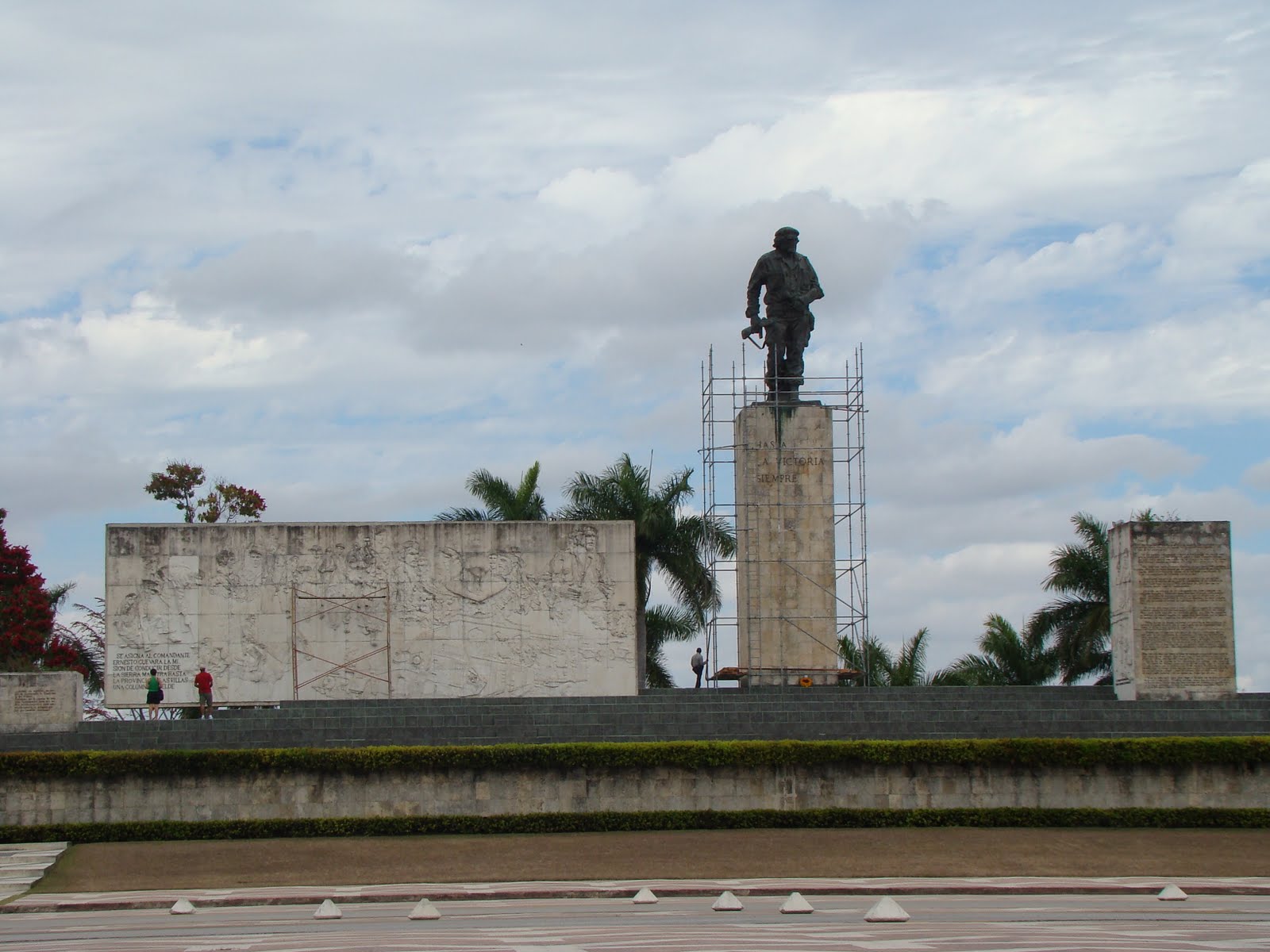
In Revolution Square there is a huge monument with a statue of him at the top and other concrete pillars with information and murals telling the story. Underneath is his memorial, a dimly lit chamber which commemorates him and others who died with him in Bolivia with an eternal flame. On the other side is the Museo Memorial El Che which
contains photographs and memorabilia of the man like a copy of his University degree certificate where he qualified as a doctor in half the normal amount of time, his uniforms, guns and letters. It is also supposed to contain the original photograph which turned into an icon of the 20th century.

We managed to visit all of these before being picked up by the taxi to go to Caibarién.

Back to Camaguey – again

Friday 19th February 2010

Rising from our bed at 4.30am we quietly showered, dressed and started to make our way out of the casa with a large rucksack on our backs and a smaller, but still heavy, rucksack on our fronts to find the door at the bottom of the stairs was bolted from the other side! Perhaps not the best omen, I unloaded the front bag and managed to manoeuvre my arm through the grating, and luckily managed to slide the bolt back. As I opened the front door a short alarm sounded but no-one appeared. As we opened the boot, I was really surprised to find that our car really was being watched by the person we were paying to watch it when he came over to find out who was fiddling with one of his charges! We have now got used to the ways of the car and we know our way out of this city and so we went our way.

We had to have the car back in Camagüey, 350km’s away, by 11.30am and although the roads are not great we made good time. After 3 hours we stopped at a ‘motorway’ café for breakfast and, with little time to spare, we placed our order quickly; the coffee arrived after about 10 minutes but it was a good 20 minutes, just as we were getting to the point of making a fuss, that the waiter came over to apologise for the delay, stating that they were waiting for fresh bread to arrive! The food arrived another 10 minutes after that; I would like to say it was waiting for, but it really wasn't, adding just a little more to the stress!

We finally pulled up outside the Cubacar office in Camagüey at about 11.10. We went in and asked for Adrian. We insisted that we would like the car checked back in and then we wanted to see the boss and make an official complaint. The man was very polite and efficient and told us that Adrian was on vacation (I think he meant day off) but he got out his phone and made a call. Obviously he spoke in Spanish, but the words I made out were the Spanish for ‘English’ and ‘boss’. He told us that Adrian was on his way and then we went and checked the car. With everything satisfactory we retrieved our luggage from the boot and were then confronted by the ‘parking attendant’ demanded a $1 cuc for looking after the car. We were both very ‘anti-Cuban’ at this point, we refused to pay saying to the car-hire guy ‘it’s your car – you pay it!’ He told us that the guy was charging for looking after our luggage but we never asked him to and I said ‘sue me’ and Paul said ‘take me to court’.

Within minutes Adrian was in the office. He put his hand out but we both refused to take it. First, we challenged him about the cost of hire. We had paid $70cuc a day; the contract read $65cuc! He immediately accepted responsibility and apologised; $70cuc was the cost of an automatic blablabla. Then we challenged him on the $5.5 overcharged on the gas; this time it took a little longer but he did, eventually, give us that back to! I still have to decide whether to make an official complaint – Paul has left that ball in my court, it’s not so much that he has any opinion, more that he can’t be bothered to do it himself!


There is not really much to do in Camaguey and what there is we have already done on previous visits. The Casa we had been shown to by one of the bicitaxi riders were not interested in helping us with finding out the times of the buses so we decided to go to the Cubatur office. The woman in there was something else entirely; I wish I could have taken her photo. She had a ‘heavy’ build with very dark skin and longish ‘afro’ hair and bright pink lipstick and a very loud voice. She had no wish to hide the fact that she didn’t have time to deal with us; she had had a very busy morning and had to get more stuff done before going onto her next office. ‘It’s my lunch’ she barked, ‘what you want, what is your question?’ We did try to get some information but she really didn’t want to know and I wasn’t about to be forced into making a snap decision just to suit her; so we left her to it.

The only way to find out was to go to the bus station. Someone had been hassling, almost following us around, ‘to take a romantic ride around the city’ so we got him to take us to the station to find out what we needed and then back to town instead. We found out the time of the bus but were told just to turn up about an hour before departure time.

One of the things we wanted to do in Cuba was to go to a concert at a ‘Casa de la Trova’ and knowing that Camaguey has a Casa de la Trova asked the rider to drop us off there. We found out that there was to be a concert that evening and that the entrance fee of $3 cuc per person included the first beverage. The doors opened at 9pm, music started at 10pm. The guy on the door invited us to come in and have a look around; with nothing else to do we not only went in but enjoyed a liquid lunch in the sunshine while listening to various musicians strumming, jamming and in one particular case, I am convinced, actually writing a piece of music. While we were in there we discussed our next move. The guide book mentions a small hotel on the beach in a very non tourist town called Caibarién. We would go to Santa Clara by bus tomorrow and stay one night then move onto Caibarién the next day. And so after two beers, and on a otherwise empty stomach, I made the phone calls to arrange our accommodation.

The music, Los Soneros de Camacho, started promptly at ten and was entertainingly traditional Cuban. Halfway through the 50 minutes set one of the older and original band members targeted us with an offer to purchase a CD; the picture on the cover was the same as one of the posters on display and Paul decided that he would have a copy at $10 cuc if he signed it for us. The live music stopped after 50 minutes and was replaced by piped music of the same ilk while the band packed up. The old guy who had sold us the CD came over to our table and indicated that he would like us to buy him a beer. I suppose we were a little affronted by this guys ‘front’ but bought him one anyway, even though we were not ready for a refill ourselves. He continued to attempt communication although, as I remember it there had been no thanks that I could make out and I’m not sure how I felt when he filled the plastic cup of a friend of his with beer that we had bought for him which his friend downed in one, but that was his choice and nice of him to be generous!

Moving to the piped music, as I do, I found myself being asked to dance by our new ‘companion’; at first I declined, but with Paul’s encouragement I got up and attempted to Salsa with the older pro which I didn’t enjoy at all and sat down again as soon as I could get away with. We still were not ready for a refill when he finished the first beer and started, well, asking for a second. Well, we both ignored this and then he got the message and left. You have to laugh; most Cubans are prepared to offer something for their ‘fee’ but some are so outrageously blatant that I just say ‘no’.

The next band started around quarter to midnight but we left shortly after that and headed for bed.


Santiago De Cuba

Thursday 18th February 2010


With a little bit of advice on direction from the landlady of this Casa we set off in our car and found the fort – with ease!

El Castillo del Morro San Pedro
de la Roca is about 6 miles from the city and was Built in the 17th century to defend the city from pirates; named after the then governor of the city, is now more generally know simply as El Morro. Designed in 1637 by Giovan Battista Antonelli, construction commenced in 1638 and took 42 years to complete. The fortification was constructed on a series of terraces with four main levels; has thick stone walls, deep moat and heavy wooden doors; however these were no match for the English pirate Christopher Mings in 1662 when he seized the fort after finding it unguarded!

In more recent times the fortress was used to imprison some of the more important figures involved in the first Cuban revolution and there is an exhibition showing the shipping manoeuvres of both the Spanish and the American fleets together with photographs and munitions used in the 1898 battle for the harbour.

We spent a couple of hours mooching around, translating the information and just enjoying the structure and the magnificent views from the structure.


On the way out we stopped off for refreshments but the place was busy serving lunch to a coach load of richer tourists and so, with no one noticing that we had even arrived, decided to move on.


Arriving back at the car, we continued on in the direction that we were parked and very quickly came across a small, almost deserted, beach with a cafeteria; it was a hot and sunny day and so we stopped. We were heading for the café when we were accosted by a young salesman telling us that his father is a fisherman and that he can offer a very good meal that would be much cheaper than the expensive café – and I found myself following him. We didn’t really want a big meal so purchased a drink, which we both really needed, from him instead. Going on the price of the beverage I would guess that his prices are not a lot different from the café, but I didn’t really mind, as long as it didn’t cost more and very soon after sitting down along came another sales pitch; this time for cigars. We listened politely while trying to get our message across that we had no intention of buying. Once he had admitted defeat, packed up and left us in peace we wandered back to the beach. Although it was still very hot the wind started to get up and we could actually see the sand being blown across the beach and could certainly feel it being blown into our faces so we decided to move on and take a look at the church.


Inglesia de la Caridad del Corbe

Apparently, three sailors on the verge of ship-wreck in the Bahi de Nipe off Cuba’s northern coast in 1606, found a statue floating and inscribed with the words ‘I am the Virgin of Charity’ although this was probably in Spanish! When the statue, a woman holding a child was taken out of the water it was completely dry and the sea instantly calmed; the 'Virgen de la Caridad' became the most important icon in Cuban Catholicism and the Patron Saint of Cuba in 1916; the church was built in 1927.

Believed to be endowed with the ability to grant wishes and heal the sick, Fidel Castro’s’ mother offered 'the Virgin of Caridad' the stuffed gorilla toy belonging to her son praying for his safe return from his fight against Batista. Ernest Hemmingway also left an offering of the Nobel medal he received for his short story ‘The Old Man and the Sea’ written in 1954; once stolen but now recovered and presently under lock and key.

As we got nearer to the town we could see the building on a hilltop and it soon became apparent that this statue is the town’s most important source of income with many, many stalls selling either associated souvenir iconography or floral offerings. At least two men actually stepped out into the road, with their hand outstretched, forcing me to stop although they did accept our refusal with grace and did not persist.

The church itself is, like many other buildings, beautiful but needing maintenance. We climbed the stairs to view the ‘lady’. The statue is about 18 to 24 inches high and is wearing a sort of golden yellow gown and carrying a child. On closer inspection with the monocular her ‘skin’ is a darkish brown, her lips are painted and she is also sporting a pair of dangling earrings. I’m not really sure if she was wearing this entire garb when she was found!

It took far longer to drive the 6kms back to the city followed by the 18kms east then it took to look around the church.

Although the car didn’t have to be returned until the next morning there was little point keeping it for another night; we would only have to pay another $2cuc to have it watched. We had to go back to the Casa to pick up the agreement before they would accept the car back but when we finally got to talk to the very busy man he indicated that the agreement did not state that we would be leaving the car in Santiago and that there would be a $70 cuc charge. It was only at this point that we realised that Adrian had ‘done us’. We explained that we had paid $70 cuc a day, $55 cuc for the tank of gas and $21 cuc extra driver charge. ‘That’s not what it says here’ he said showing us that the 65 on the page was the amount that Adrian had written down as our daily charge and that 49.5 was the amount he had written down as the charge for gas. The guy in the Santiago office was incredibly patient and did his best to sort out the problems but asked us to come back in about 15-30 minutes as he couldn’t get through to the Camagüey office.

Feeling really angry, more with ourselves for not have checked more carefully, we went upstairs to the Grand Hotel for a pizza, comfort food in an uncomfortable situation. Four were offered; Neapolitan, ham, tuna or house special. We both chose the special – which was, as it turned out, a Neapolitan with a bit of ham, a bit of tuna, some mixed (out of the freezer and now soggy) vegetables with a hard boiled egg cut into quarters and arranged in the centre. I have to say this was possibly the very worst pizza I have ever had the misfortune to order; and then they tried to overcharge for it. We asked for the bill and we were told $22.50 which we immediately queried and I asked her to write it down. While she was away talking to the other waiting staff I grabbed a menu and worked it out to be $15.50cuc. By this time she was back and now asking for $16.50 – she picked the wrong time to get it wrong! We told her how much it was, gave her the exact money saying ‘you won’t be expecting a tip will you’.

While we were eating we discussed the situation and decided that we had to get this sorted and the only way to get it sorted was to drive back to Camagüey leaving Santiago at 5.30 next morning to get the car back by the 11.30 deadline. We went back to the Cubacar office and after a little more discussion we thanked him for his help and advice and confirmed what we intended to do. The day had been well and truly ruined and we disliked both Cuba and all Cubans, well maybe not all; we put $20 cuc more gas in the tank and returned to the Casa, paid our bill and prepared to leave early in the morning.